
Optimizing Shame
Planning for failure without planning the failure

Last week, Harjas Sandhu made a solid post about what he calls “indulgent asceticism”, a cycle that many of us are likely familiar with: decide you want to give something up, set an unrealistic cold-turkey goal, feel good after you’ve abstained for a while, consequently loosen the reins and allow yourself to indulge just a little now that you’re over it…and experience crushing shame that makes you spiral more than ever before.
From a secular frame, the cycle he describes is on-point (there were a couple of points about the middle way in his post that weren’t quite accurate to Buddhism though, which he noted). But we diverged on what we think the underlying cause of the cycle is: while Harjas grounds the issue in the unrealistic goals themselves, I think ambitious goals are good, and the problem lies in how we manage shame when we inevitably fail along the way to achieving them.
“Shame” is a prickly word, so let me clarify what I mean by it before moving forward. The Buddha teaches that hiri, sometimes translated as “wise shame”, is one of the guardians of the world.1 “Conscience” is another popular translation, but I think these are really the same: wise shame is conscience. There is a reasonable debate to be had about the nuances of shame, conscience, guilt, etc., but that is for another post. Suffice to say that I’m using “shame” to describe a general feeling of moral pain. I do not mean toxic self-condemnation, and I do not mean shaming others. If you find the word itself unhelpful, feel free to mentally substitute something else.
Back to goals. Let’s take an example. Buddhists have a Herculean task in front of us: overcome the world entirely. That is about as hard and unrealistic of a goal as you can get. Working towards that at all implies failing. It’s bound to happen. And that leaves us at risk of falling into the cycle.
But what’s the alternative? Just abandon the practice entirely because the goal is too hard? Well, that is the cycle, so it’s hardly an alternative solution!
Even if your goals are more realistic, like reducing your screen time, the fact that you’re setting that as a goal means it’s still hard — if it were easy, it wouldn’t be a goal, it’d be a “done”. You set the goal because you’re already failing at something you want to succeed in. Why think you won’t fail again along the way?
In my mind, the question comes down to this: how do we balance the need to set ambitious goals with the need to avoid spiraling when we fail at them? How do we ensure that failures are pit stops and learning opportunities, not catastrophic crashes?
The shame optimization problem
There’s something very interesting here. The failure mode of the cycle comes from shame. But the starting condition that leads us to set the goal in the first place also comes from shame! Why is it that the shame in regard to our baseline failure — our lowest point — motivates us, but then the shame from the continued failure after we’ve already made some progress makes us throw it all away?
We can think of this as the shame optimization problem. Shame is unavoidable, and it can be both constructive and destructive, either a bitter medicine or a poison. Or in other words: the dose makes the poison. So how do we optimize the dosage to get the maximum benefit?
Consider a (simplified) dose-response curve for a popular psychiatric medication, like amphetamines for ADHD:
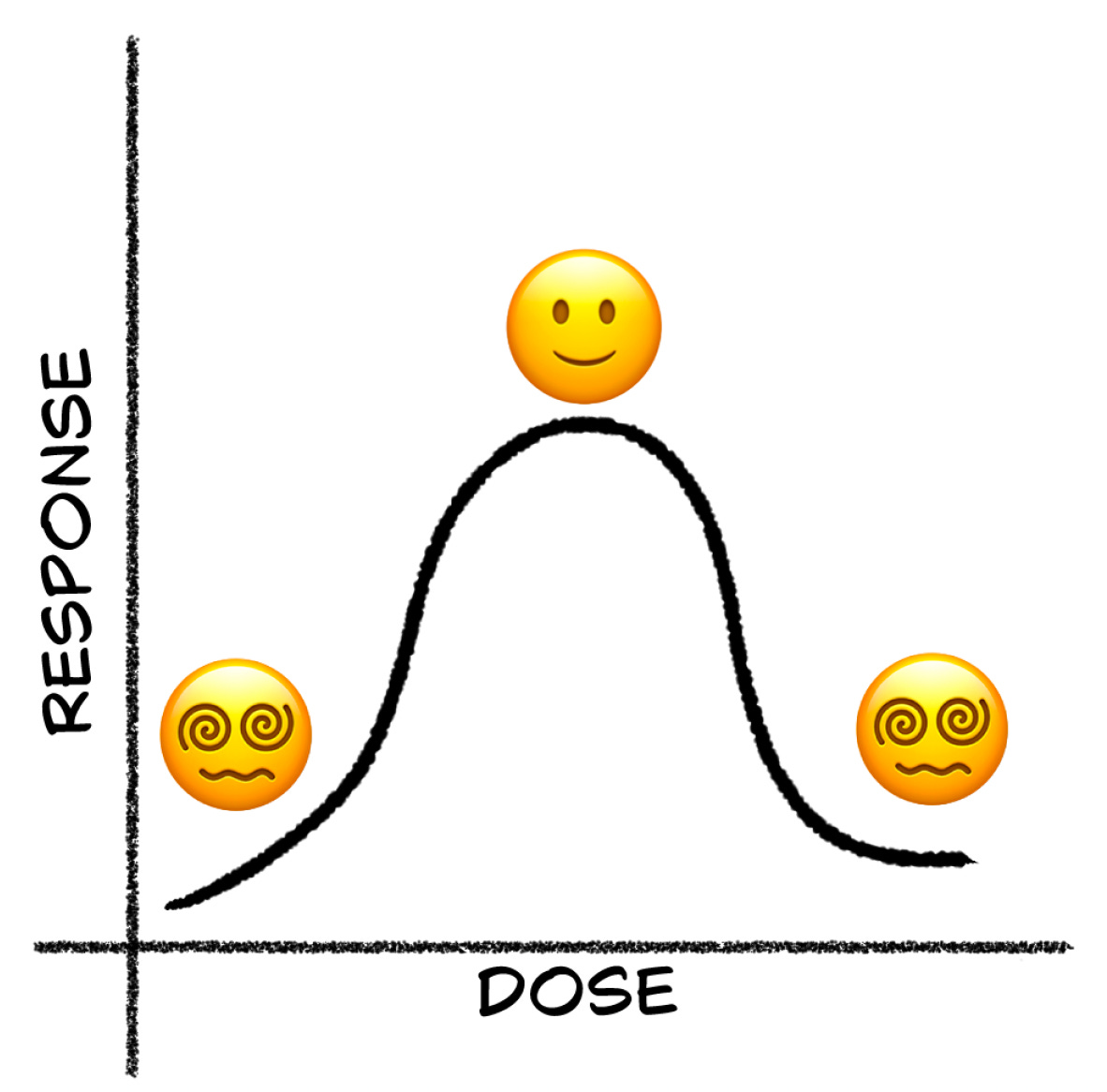
When the dose is too low, the patient is symptomatic and incapable of completing their tasks. As the dose increases, they start to become increasingly capable, until they hit an optimal dosage, at which point they are at their most capable.
But once you go past that point, things start to go downhill. Instead of getting more and more productive, the benefits plateau and side effects steadily overtake them. Take too much, and you get anxiety, heart palpitations, insomnia, or even mania or psychosis.
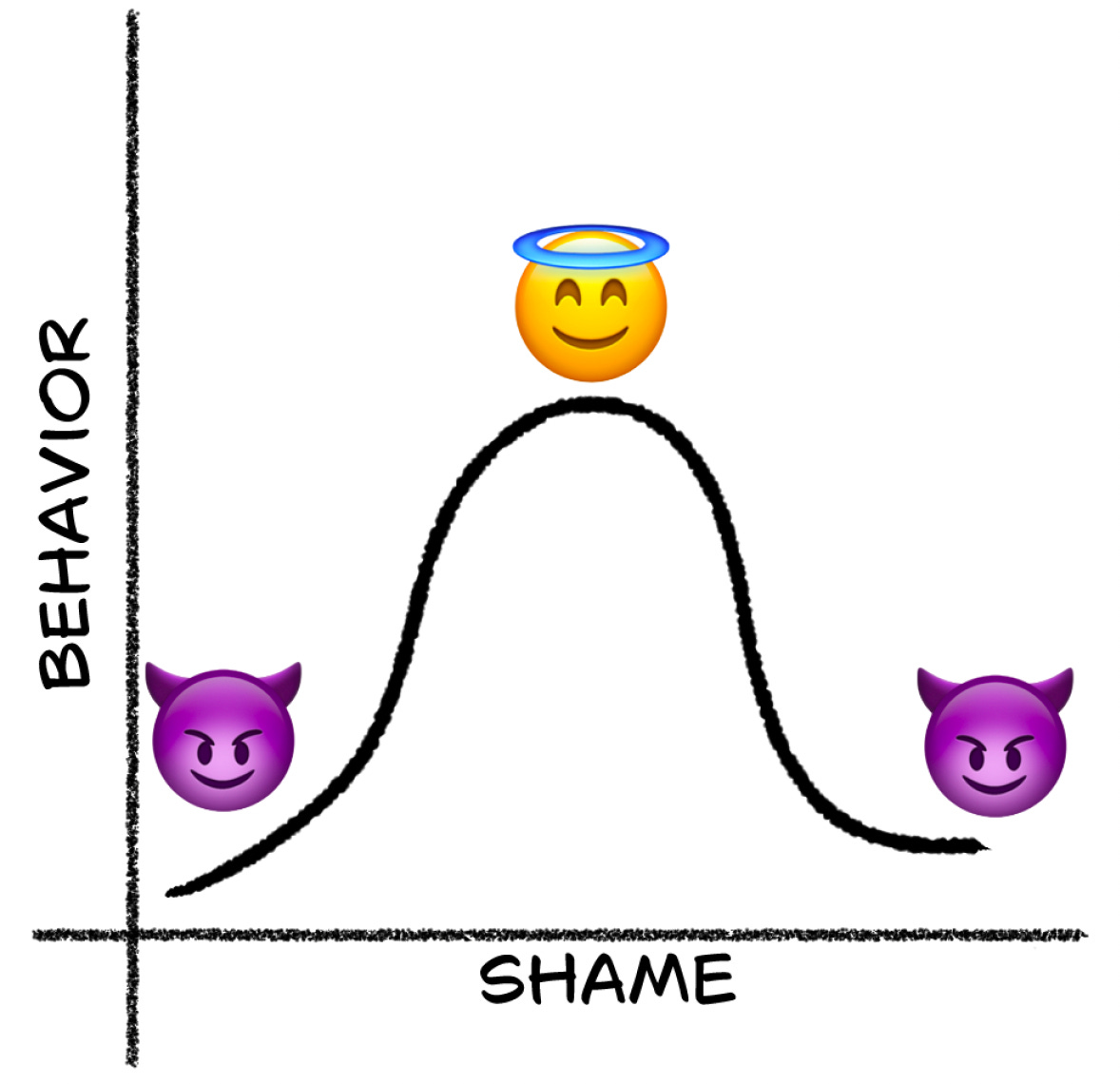
Now let’s consider how that plays out with shame. Consider a married man whose coworker flirts with him, and so he begins to consider cheating on his wife. The optimal response is obvious: he should notice those thoughts, feel ashamed of them, turn away from them, and set up boundaries with his coworker as a corrective action.
But what happens if the dosage of shame is too high or too low? If it’s too low, the man might continue harboring those thoughts, become used to them, and then escalate to acting on them. If it’s too high, the shame may make him start to think of himself as a failure of a husband or a bad, unfaithful person, and that could lead him to sabotage his marriage because he believes his wife deserves someone better anyway.
You can see how that could continue to play out if he does cheat: with the right amount of shame, he ends the affair and comes clean to his wife. Too little shame, and he continues. Too much, and it could escalate further, perhaps into a pattern of cheating with more women — there is a known addiction mechanism where people try to escape shame about their addiction by numbing themselves through their addiction.
So the dose-response curve for shame is something like this:
I want to pause to note something important: before optimizing the dose of a medication, you need to make sure it’s the right medication. Everything I’ve said so far has skipped that crucial step.
Unfortunately, a lot of people prescribe shame for themselves where it isn’t indicated. Sometimes, our shame response is just totally off and uncalibrated, but that process of calibration is too much to go into in this post. For now, the important takeaway is this: do not just blindly trust your shame. Optimizing shame is only useful when you’re sure it’s actually the right medicine. That’s part of what makes it wise shame. And for most people, shame optimization and calibration will likely require reducing or eliminating instances of shame, not kindling or expanding shame. However, I still see that as an optimization problem: sometimes the optimal dose is none.
So we can see here that shame can be good, but only when it is optimized and calibrated. The problem, then, is how we manage our dosage of shame so that it keeps us on the right track without destroying us.
Shame management: diluting the medicine
The tricky part of this question is that we can’t directly adjust our shame dosage: shame simply arises dependent upon conditions. If you grew up in an abusive household, for example, you are more likely to feel more shame than average, and that isn’t something directly in your control. Unfortunately, that means that some of us will be predisposed to carrying an unhealthy amount of shame, and some will have a well-attuned response right from the get-go.
Since we can’t directly manage the shame itself, we have to work with something else: its structural container. We have to dilute the shame with a greater context so that it can be absorbed in a manageable way. Luckily, no matter what your starting conditions are, you have the ability to work with this.
So what exactly is a structural container for shame? In short, I think of it as a sort of preemptive view, attitude, or plan we cultivate to prepare us for the inevitable experience of shame. That way, when it eventually does crop up, we have the cognitive tools we need to deal with it skillfully.
The first tool we can rely on is something that we’ve already been circling: an awareness of the inevitability of shame. When shame is seen as a basic, unavoidable fact of life, it stops being a catastrophic drama when it arises. In fact, if you never feel any shame at all, that’s likely worth examining. Everyone has something they can work on. Cultivating this view can help prepare us for that work.
The second tool is an awareness that shame doesn’t last forever. It peaks, then mellows. When you keep that in mind, you can remind yourself that your thinking is likely distorted at the peak, so it’s best to give yourself a cool-off period when you feel it spiking.
The third tool is an awareness of the universality of shame. If everyone needs to improve on things, then the arising of shame is not a unique, personal indictment of your character. It is actually the connecting line between you and the people you consider good. Shame is a sign that you possess the wonderful qualities of self-awareness, care, and a desire to develop your virtue. Whether you follow through on that development is a separate issue, but fundamentally, shame is the seed that, when watered with action, grows our goodness.
And here is an extremely important corollary of that last tool: you are not your shame. Most spiraling happens when we identify with our shame. Don’t let that happen, and you cut off most of the issues with one fell swoop.
Setting goals with a compassionate container: planning for failure without planning the failure
Let’s return to the indulgent asceticism cycle to see how we can use these tools to avoid it.
Say you want to become vegan. There are two ways you can do this: (A) allow yourself some cheat days to ease into it or (B) go cold turkey.
Both of these come with risks. The main benefit of (A) is that it feels more manageable, and that makes it easier to set the goal in the first place. But you also risk sabotaging yourself right from the start — your goal isn’t just to reduce your animal product consumption, it’s to stop consuming them entirely. By easing into it and allowing cheat days, you’re managing shame by redefining failure. But if you truly want to be vegan, then eating animal products is a failure, and telling yourself it isn’t changes how you view the goal — it shifts your telos.
So this strategy can definitely work, but there’s a risk of shifting the goal posts. To be clear, the action of gradual reduction is not what I’m flagging as risky. The risk comes from not clearly maintaining the view that your cheat days are still cheating. Your actions are downstream of your views, and without cultivating the vegan view, there’s a risk of being lulled into complacency, making your cheat days your new normal, and never actually reaching the goal, all while telling yourself that you’ve succeeded.
On the other hand, if you try the cold turkey approach, the risk of catastrophic failure is higher: it’s much more likely that you’ll make it a week or so, cave, have a bite of cheese, and then fail with abandon.2
I can tell you personally that when I first tried to be a vegetarian, I decided to have a pasta dish with chicken one day, and then I ended up eating meat for another six months before taking up the practice again. It was a direct result of not cementing the idea that eating meat was fundamentally contrary to the direction I wanted to go in.
At the end of the day, neither of these are ideal. So here is my solution: planning for failure without planning the failure.
The concept is simple: you set the firm intention to abstain entirely, orient yourself around that, but accept that the reality of your behavior won’t necessarily immediately fall in line with your intention. Aligning your behavior and intention is the practice.
You may find, for example, that you need to allow yourself some cheat days, but you don’t view this as simply okay, you view it as a mistake. The cheat days become a “break glass in case of emergency” pressure release valve, not a planned reward for your temporary success. When the cheat day approaches, you don’t automatically take it, you ask yourself if you really need it. If not, you hold off. If you do feel you need to turn the pressure down a bit, you take the cheat day while remaining aware of the fact that this is contrary to your goal. That cements the view you need to succeed.
That shifts the landscape significantly. The cheat days become something you want to avoid, not indulge in, because you still cultivate a sense of wise shame around them. But you have set up preemptive structures that make that shame manageable: it’s not ideal, but it’s not catastrophic. You see mistakes as feedback instead of identity-level condemnations.
In other words, you plan for failure, but you don’t plan the failure.
And you allow yourself to fail without being a failure. You allow yourself to fail at X without being a failed X.
To make this a bit more concrete, consider how a piano player approaches their craft. Say they want to learn a song. Learning that song will require playing the wrong notes until they learn the right ones. Playing too many wrong notes might make them frustrated and feel they aren’t improving. Do they tell themselves, “I’ll play wrong notes on Tuesdays”? No, they just set up a container: getting better entails playing the wrong notes, but acknowledging that they’re wrong is how you learn to play the right ones.
I’ll give you an example of how I apply this in my own life. My pen/artist name is Otto the Renunciant. But I am not a renunciate in the concrete sense of the word — I am not a monk, I am not living in a cave, etc. Although I think I live a pretty ascetic life by most people’s standards, I’m indulgent by monk standards. I mean, I post music on here. So why call myself that? Because it helps orient myself around where I eventually want to go.3 So long as I create under this name, I will never fool myself that my indulgences are fine. I accept that my current position means I am fail-ing at being a renunciant, but not that I am a fail-ed renunciate.4
I feel what I think is a healthy amount of shame around this, and I have considered changing my artist name to avoid even that. But ultimately, I think that is playing into the cycle I described above. And here is the interesting part: the shame from changing my name (at least for the purpose of giving myself some leeway) is actually large enough that I’d rather just keep dealing with the shame that crops up from not living up to my goals than I would the shame of giving them up entirely. And because shame is unpleasant, it creates a sort of “no going back” effect: the trajectory is biased upwards, even if not linear.
Humility: Christianity’s shame optimization strategy
Although I’m a Buddhist, I have to hand it to Christianity: I think that when the Fall, original sin, and humility are at their best, they naturally point us in this direction.5 Granted, the real-world application and teaching of these concepts often goes catastrophically wrong, but I want to focus on what I consider their ideal implementations.
Ideally, viewing oneself as a sinner shouldn’t be self-flagellation, but self-compassion. It means that Christians acknowledge they have taken on a task (the emulation of Christ) that is superhuman in its fullest form. They are bound to fail, but that doesn’t mean that they shouldn’t try — it means that they need to fall back on love when they inevitably fall short. Sin is expected, but so is continued effort.
Importantly, this isn’t a love that simply accepts us where we are: it accepts us where we are while also encouraging us to grow, because that is what is best for us, and true love always wants what’s best for us. True kindness to ourselves is not avoiding our shame entirely, but compassionately acknowledging where we are while lovingly guiding ourselves to where we need to go.
This is what I think humility is really pointing to: not the pride and self-hatred of self-flagellation and indulgent asceticism, but the ability to say “I have failed, and the best way I can love myself and others is to pick myself up and try again”.
Shame in a container of hatred is a weapon and a poison, and this is where most people go wrong. But shame in a container of love is humility. And humility helps us see our shared humanity, ignites our compassion, and points us in the right direction.6 When shame is seen in that light, it stops being a disease and becomes a stirring of the heart that calls us to growth.
The call may not be pleasant, but no one said the medicine is supposed to taste good. It’s just supposed to work.
See AN 2.9. Ven. Sujato translates hiri as “conscience” in this case, but other translators use “wise shame”.
“Fail with abandon” comes from Nate Soares’s article Failing with Abandon — definitely worth a read.
Also because I want to frame my music as something to be let go of, not something to hold on to — that was the original intention. What I’m describing here was actually a lucky side effect of a creative choice.
I’m trying to stress the etymology of -ant vs. -ate here: the former is reminiscent of the present participle in Romance languages, expressing an ongoing and uncompleted action, while the latter is reminiscent of the past participle, expressing a completed action. This may not be entirely linguistically/morphologically accurate, but this is how it personally lands for me.
Buddhism has this as well with the puthujjana/ariya divide and ignorance, which is present in everyone except for arahants, paccekabuddhas, and buddhas, but it’s generally not stressed as a central facet of the faith in the way humility is in Christianity.
You can check out my post A Drop of Ignorance Is Too Much for more on how our liability to wrong action unites us.
Very interesting article, Otto. Thank you.